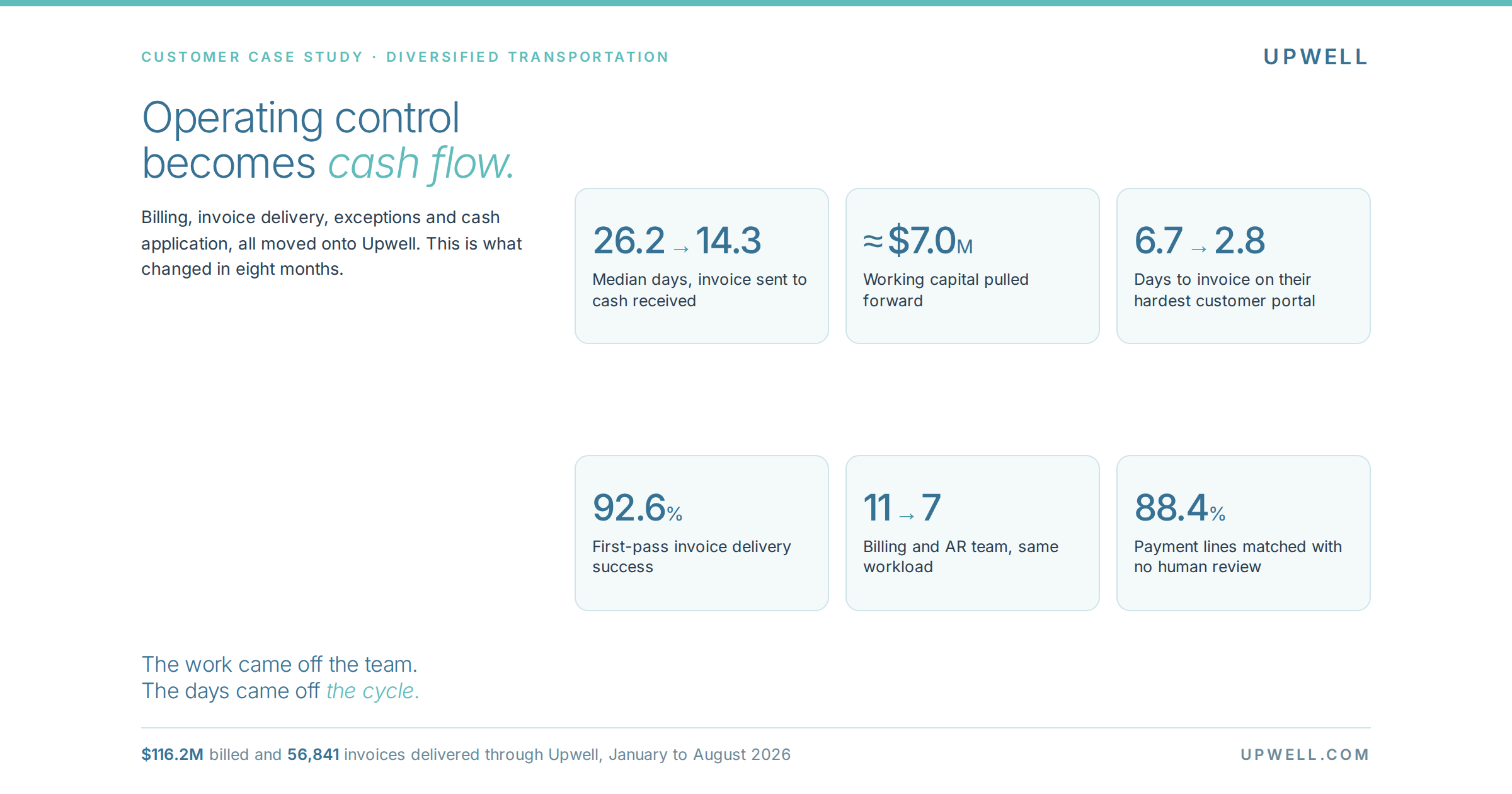
A diversified transportation company moved billing, invoice delivery, exception management, collections and cash application onto Upwell. Eight months of production data, January to August 2026.
At a glance
The company cut the time from invoice sent to cash received by 11.9 days. At its current billing run rate, that is roughly $7 million of working capital pulled forward.
| Measure | Before | After |
|---|---|---|
| Median days, invoice sent to cash received | 26.2 (Jan) | 14.3 (Jun) |
| Days from delivery to invoice, hardest customer portal | 6.7 (Mar) | 2.8 (Aug) |
| Days from delivery to invoice, all volume | 5.1 (Mar) | 3.8 (Aug) |
| First-pass invoice delivery success | 84.5% (May) | 92.6% |
| Automated customer statements sent per month | 16 (Jun) | 111 (Aug) |
| Billing and AR team | 11 people | 7 people |
Across the engagement, $116.2 million billed and 56,841 invoices delivered through Upwell.
The company
A diversified transportation company running both asset-based trucking and a brokerage operation. Its customers are national food and consumer goods shippers, which means a high share of freight bills through customer portals and freight audit and pay platforms rather than by email.
That mix is what makes the billing hard. Asset and brokerage loads follow different paths to a customer invoice, portal requirements vary customer by customer, and the documentation a portal will accept is not the documentation the next one wants. Volume through Upwell ran to $116.2 million and 56,841 invoices over eight months, across 22 customer portals.
The challenge
In January, a dollar billed took 26.2 days to become cash. None of that was a collections problem. It was the accumulation of every step between a load delivering and a payment clearing, and nearly all of those steps ran through a person.
Billing ran out of a TMS that handles freight well and was never built to be an accounts receivable system. Asset and brokerage loads shared one instance, so receivables for both sides were commingled in the same place.
Invoices went out through dozens of customer portals and freight audit and pay platforms, and no one had an inventory of which portal belonged to which shipper. Each had its own requirements. Several wanted a spreadsheet alongside the PDF, keyed by hand with invoice number, BOL, fuel and mileage broken out line by line. Others required accessorial charges on invoices separate from line haul, which the team handled by maintaining a distinct bill-to code for every charge type, in one case twenty codes for a single customer, and assigning them manually at billing time.
Uploads were split between the AR team and customer service, so tracking a submission meant checking whether someone had done it and then working whatever had failed.
Incoming payment was harder than outgoing. A full-time person did nothing but cash application. Apart from a handful of large payers whose files could be imported, remittances were posted by hand every day, down to penny-level short-pay adjustments.
Almost none of it was written down. The rules for how each shipper wanted to be billed lived with the people who had been doing it longest, which made a week of vacation a week of billing that waited.
|
26.2 days
invoice sent to cash received
|
5.1 days
load delivered to invoice sent
|
1 in 6
invoices rejected on first submission
|
How the engagement began
The company's CFO was referred to Upwell by the CFO of another transportation company built the same way, with both asset-based trucking and brokerage. Evaluation started that quarter.
Eight weeks from signature to Upwell carrying live portal volume, and five months to the full order-to-cash cycle.
What they moved onto Upwell
The engagement covered the full order-to-cash cycle. Each workstream takes days off a different part of it, and those days add up.
- Invoice delivery and portal submission. Rules configured for each customer to match what their portal requires, so invoices are assembled with the right documentation and submitted across 22 portals, with email delivery for the rest.
- Exception management. Rejections and short-pays surfaced with the reason attached, so the team works the failure instead of discovering it.
- Customer statements and reminders. Sent on a schedule rather than when someone gets to them.
- Collections. Receivables and collector assignments pulled from the TMS, worked in one place.
- Cash application. Remittances parsed and payment lines matched against open invoices.
The rollout was phased by customer batch rather than switched on at once. Portals went first, receivables and cash application followed, and remittance processing reached full production volume in mid-July.
Result: invoices go out faster
An invoice cannot be paid until it is sent, so billing speed is the first place days come off the cycle. The company measures it from the day the load delivers to the day the invoice is submitted.
| Q4 2025 | Evaluation, driven by increasingly complex customer billing requirements across a growing portal footprint. |
| December 31, 2025 | Signed, covering portal submissions, invoice delivery, exceptions, collections and cash conversion. |
| January 2026 | Implementation began immediately. Upwell progressively assumed responsibility for customer portal submissions and the billing workflows around them. |
| March – August 2026 | Expanded across all five workstreams, through to statements, reminders and cash application. |
| Month | All volume | Hardest customer portal |
|---|---|---|
| March | 5.1 days | 6.7 days |
| August | 3.8 days | 2.8 days |
The account that improved most was the one that had been worst. It carried the highest volume, the most documentation requirements and the most re-keying, and it now bills a full day faster than the company's overall median. The portal's requirements did not change. What changed is that meeting them stopped being a manual job.
Result: invoices get accepted the first time
Most billing teams treat a rejected invoice as a quality problem. It is a cash problem.
On most payment terms the clock does not start when an invoice is sent. It starts when the customer accepts a valid one. A rejection costs the rework, and it costs every day between the first submission and the second, before net 30 has begun counting at all.
First-pass invoice delivery success went from 84.5% in May to 92.6%. Read as failures rather than successes, that is 52% fewer invoices rejected on the first attempt.
By August, 97.7% of invoices needed no exception handling of any kind. The remaining 2.3% is where the team spends its time now, and those are the invoices where an experienced person is genuinely needed.
Result: receivables stop quietly aging
An invoice can be delivered, accepted and completely correct, and still sit there aging because nobody is chasing it. That is the quiet gap in most AR operations. Billing gets attention because it is visible. Follow-up gets whatever time is left, which is usually none.
Automated customer statements went from 16 in June to 111 in August.
A customer statement is the running summary of everything an account still owes. Sent on a schedule, it surfaces an aging receivable while it is still a reminder rather than a collections problem. Seven times the statement coverage is seven times the number of accounts getting a nudge before anyone has to make a phone call.
Result: cash clears without waiting on anyone
Getting invoices out correctly is the first half of order-to-cash. Clearing the money that comes back is the second, and it is the half most automation projects never reach.
A payment that matches automatically is applied the moment it arrives. One that needs a person sits in a queue, and while it sits the money is in the bank but the aging report, the collections list and the month-end close are all still days behind reality.
Across 31,192 payment lines in 1,205 remittances:
- 99.2% matched to an open invoice
- 88.4% matched automatically, with no human review
Remittance formats in freight are not standardized. The same company receives consolidated remittances covering several customers at once, spreadsheets that pay a subset of the loads listed, PDFs with no discount detail, and files keyed on BOL numbers rather than invoice numbers. Those are the figures roughly six weeks after remittance processing reached full production volume.
|
“Upwell's done a lot of really awesome things for AR. It's a good product.” — Accounting Manager |
What it did to the team
The same billing workload now runs with a smaller team. The billing and AR group went from 11 people to 7, which is roughly $185,000 of annual capacity reassigned or reduced.
The work that required eleven people now runs smoothly with seven. That capacity gets reassigned to other departments or to higher leverage work. The team now manages exceptions, disputes, collections and the things that actually require human judgment.
The effect compounds with volume. Portal uploads, re-keying and aging spreadsheets scale with the number of invoices. Exceptions do not, and this client's exception rate fell to 2.3%. Added billing volume no longer requires added headcount.
What it adds up to
Every result above is a few days or a few hours. They land in the same place.
| Month | Median days, invoice sent to cash received |
|---|---|
| January | 26.2 |
| March | 19.4 |
| April | 16.1 |
| June | 14.3 |
That is 11.9 days faster, a 45% reduction. At the company's billing run rate of roughly $588,000 per day through Upwell, 11.9 days of cycle time works out to about $7.0 million of working capital pulled forward.
At enterprise transportation scale, that shift in timing is the difference between financing receivables and being funded by them.
It is worth being precise about what that figure is and is not. It is not new revenue, and it is not a cost saving. It is the same dollars arriving almost twelve days earlier, on every billing cycle. The company did not change what it hauled or what it charged. It changed how long each dollar sat in receivables before it became cash, and the effect grows with every additional dollar routed through the same workflows.
How these figures were measured
All figures come from this customer's production data in Upwell, January through August 2026.
Invoice to cash. The median across all invoices billed through Upwell, measured from the moment the invoice is delivered to the customer to the moment payment is received. Both the January and June figures use invoice groups that have been substantially collected, so this is not new invoices being compared against mature ones. Cash conversion can only be measured honestly on cohorts that have had time to pay, which is why this metric ends in June while the others run to August.
Delivery to invoice. Days from the load delivering to the invoice being submitted, measured per account and across all volume.
First-pass delivery success. The share of invoices accepted by the customer or portal on the first submission, with no rejection and no resubmission.
Cash application. Payment lines from remittances received in production, matched against open invoices. "No human review" means the line was matched and applied without anyone touching it.
Working capital. Days of cycle time reduction multiplied by the average daily billing value routed through Upwell. A timing calculation, not an accounting figure.
The customer is not named at their preference. All figures are theirs and unadjusted.
Working with Upwell
Nothing here required the company to change its TMS, renegotiate payment terms, or ask a single customer to do anything differently. The portals kept their requirements. The shippers kept their terms. What changed is how much of the work between a delivered load and a cleared payment a person had to touch.
|
“In hindsight, it was one of the better decisions we made.” — Finance Executive |
If your billing team is submitting to customer portals by hand, reworking rejected invoices, or applying cash line by line, the same days are sitting in your cycle. We will show you where.
Book a working session